
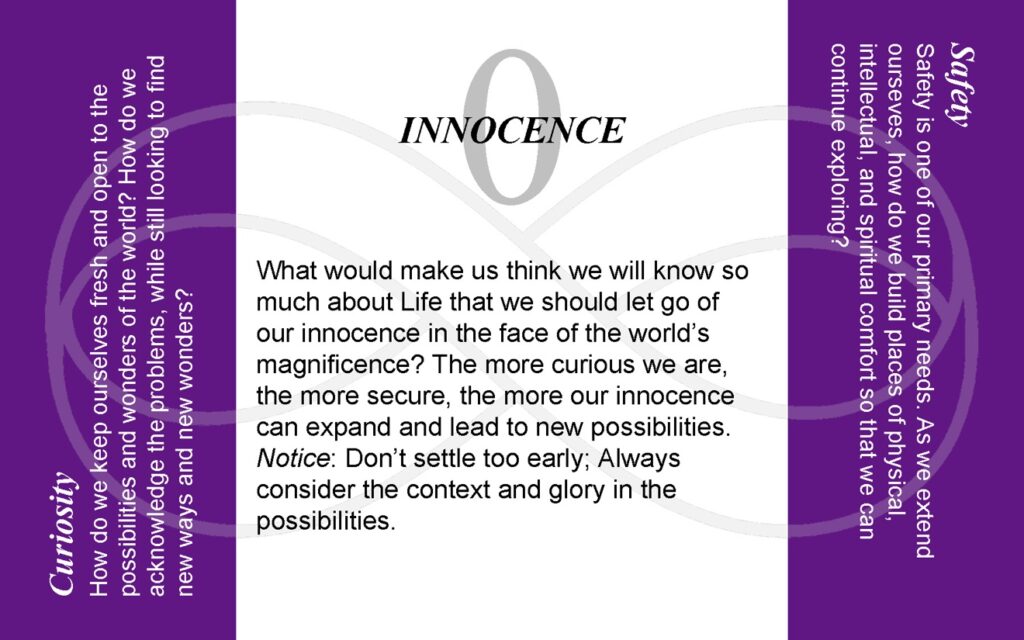
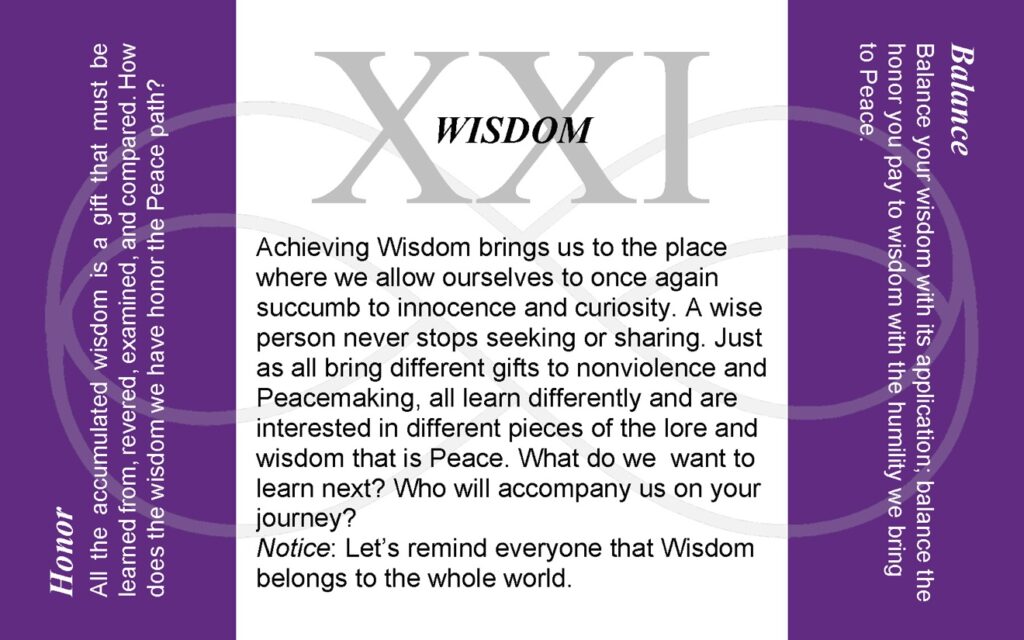
For many long years (gasp, nearly 50!) I have studied Tarot. Occasionally I cast cards for money, but mostly I’m interested in learning about Tarot and how people use and interpret the cards. When I retired from the ministry at a local Unitarian Universalist Church about six years ago, I decided I wanted to take a different look at the Major Arcana. The 22 power cards are the most interesting — and the most problematic for me. As a Peacemaker, the notion of hierarchy in practice is unacceptable. I find the archetypal images not only to be hierarchical, but also racist, sexist, ableist, and as well as out-of-date in the way I had learned them. I was also discomfited with the ways many depicted reversals, as the opposite of the good or the Possible.
Many people have changed their ways of thinking about them and their interpretations, yet those images remain iconic. It is for that reason that I decided to see what happened if I worked with a deck that was all words. After all, in addition to being a Peacemaker, I am a poet. It is true that many of the decks, both ancient and new, are gorgeous — and yet, for me, still etch the notions of the cards containing at least problematic predictions and images. I realized I could whine and complain about cards that work so very well for so many people, people who do deeply creative and interpretive work, or I could build my own cards that satisfy my need to travel – in my own way of traveling – on a Journey into Peace and Possibility.
Writing and considering was an extraordinary adventure. I think I knew that leaving public ministry would be a wonderful time to do a solo journey with the Major Arcana. It was a respite and a retreat that helped me transition from public work to personal exploration. I thought at the beginning I might just keep writing through the whole deck, but I found my conversations and explorations with these 22 cards deep enough to occupy me for the time being.
Once they were written and produced, they demanded a great deal of work to understand what insight and advice they had to offer a card spread. Over time I realized that my cards are not offering prescriptive advice. Instead, my cards ask questions about how our lives, projects, relationships, nation might change if we only considered the wisdom these cards were offering. They were an invitation to contemplation, and perhaps cooperation.
However, it wasn’t simply the different insight the cards offered on the concepts the archetypes embodied, it was also that each Wisdom card had two positive polarities that existed, not in opposition to one another, but in a connection forged by a Möbius. If you’re at all like me, you may not immediately know that a Möbius is a “two-dimensional surface with only one side and one edge” (I asked Wikipedia, because I can never remember that exactly). The two Positives are not in opposition; they may be described as directions. It takes time. I’m still learning what they’re trying to say. Usually, however, they’re not shy about suggesting that consider deeply!
The Möbius is not only part of each card (and in the next iteration of the cards, it may become more visible). The Journey itself, as it moves from Innocence in the direction of Wisdom, is at the same time moving back to the direction from which it came.
Salaam, Shalom, Peace, and Blessed Be!