
Oh, how I love to sing. Thankfully, I have a good voice, so I’ve gotten to sing on stage, in choirs, in Peace Marches, and in groups around fires and altars. Well, and sometimes I sing in the car. Why listen to the radio, when there’s something you’re interested in or a new chant to write? The song referenced in the title is by Holly Near. She wrote a lot of songs that are perfectly suited to Peace Marches and a few good for singing around the fire. That moment in a group when someone starts a song, and we all search for our harmonies and simply sing out, these are Sacred moments to me.
We’re watching this type of singing happen in Minneapolis right now. There is a group called ‘Singing Resistance’. They’ve organized sings in churches and auditoria where the acoustics allow the sound to envelop the singers. They’re on the street inviting other protestors to sing along. And they do, oh, do they! In between the cadence of “this is what democracy looks like” arise voices prayerfully, harmoniously, raised in song. There’s still a beat, often slow and stately.
This Substack is reader-supported. To receive new posts and support my work, please consider becoming a free or paid subscriber. And Sing! And Make Peace!
What effect does the singing have on ICE officers, I wonder. Does it enrage them? Does it provoke violence? What if that singing has the same effect on them that it has on the protestors? One of the things I adore about music is that singing together has the power to transform us. It brings us into the song, the beat, the words, the sensation of it. That’s why hymns are so important in Protestantchurches and communities of faith. They took the music from the choir and gave it back to the congregation. Music solidifies team spirit, It’s why we hear so much of it both in war and football games. But folks in Minneapolis are standing up in Peace. Their songs are not only saying no to ICE; they are saying “yes,” to their neighbors. They are saying, “we’ve got you.” They are saying this is our country. They’re singing, for as the song reminds us, “We won’t be silenced anymore.” Not simply resistance; but also, another equally unlikely truth of Possibilities for Peace. These are shared truths that give us all courage — encouragement to stand fast.
While I focus on standing and working for Peace in these moments, at the same time, many amazing people are working against this brutal regime (who would have thought I would be saying that about an American presidency?) As I keep saying, it takes all of us if we’re going to turn this around. We have different gifts. If we use them in collaboration, we’re moving toward a new democracy. The ICE agents who are standing there are not moving toward democracy. They are moving us closer to authoritarianism. However, when we’re singing, we’re wielding a powerful tool. I believe the songs that are joining our hearts, our whole bodies, and minds, uniting us, have to be impacting them as well. This is the life giving, life changing, power of music. Bulletproof vests can’t keep music out.
Even now, as ICE defends against Music’s power, the pulse will be working against their anger likewater dripping on intransigent rock. Song has the power to drip and drip and slowly erode that rock.So, have courage, my friends. And sing out! In fact, Lift Every Voice and Sing!
People are writing new songs. Have you listened to Jesse Ware? He’s singing out. To no one’s great surprise, Bruce Springsteen has written a protest song that honors both his earlier era’s “The Streets of Philadelphia” and a tune by Bob Dylan. Other people I probably haven’t heard about yet are doing the same. I’m grateful for them. I look forward to listening to them — and maybe even singing along.
Yet what really changes us as people are simple repetitive choruses that we sing together. Choruses that we can embellish with harmony. Remember “We shall Overcome?” Together with Negro Spirituals, songs like this are how the Civil Rights Movement gathered their courage to march across that Bridge in Selma and endure everything that came before and after it. Dylan wrote “And the Times They Are A’Changin’” in the middle of the Race Riots and the Vietnam War Protests. Before that “Which Side Are You On?” was a Union “zipper song,” which allows you as one, to offer an example of injustice and finish with the repeated question: Whose side are you on? Decide. Bread and Roses was an anthem.That anthem reminds us what is still true today: “We need bread and we need roses, too.” Yes. We need Peace and we need Justice, too. We are desperate for “Justice to roll down like water, and righteousness like and ever-flowing stream.” Amos 5:24
My ancestors have been singing in little stone Protestant churches for generations. My roots are, among others, of Welsh miner stock. The first tunes I learned to play on the piano were hymns. I taught myself to play as I was learning to read music. Thump, thump, thump. Those hymns echo through generations of my forbears, right down to me, even when, as is often the case, I can’t stand the theology they convey. Hymns were written to bring our hearts into the same pace, the same place, the same Peace. Early hymnodists may not have known about the way our nervous systems react to music, but they had the formula down. And ‘Singing Resistance’ is finding it, spreading it, transforming it into the slow, steady drip to erode hardened hearts and minds.
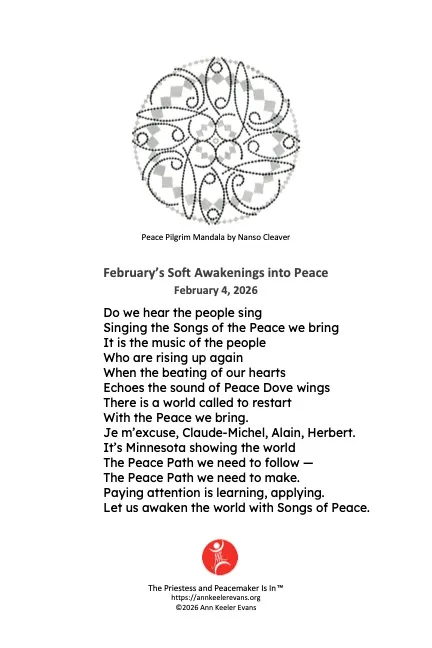
Recently I haven’t been able to get a song out of my head — the big song from Les Misérables, ‘Singing the Song of Angry Men.’ And each time I hear it, I think this is doing exactly what I don’t believe in. However, since it persisted, I messed with it, with great apologies to Les Miz composer Claude-Michel Schönberg and lyricists Alain Boublil and Herbert Kretzmer. I put my “first take new lyrics” into the beginning of my February the 4th Daily Musing, which now I offer you below.
Please, take heed, these are unusual times. What that means to us as citizens of America, is that we have the possibility, we have the power to change the direction and the culture of our country. Possibilities of substantive change are opportunities that We the People are confronted with only every 100 years or so. We can’t focus on and wring our hands over the horror of it all. We must search for the Peacemaking Possibilities that exist. We Need Peace and we need Justice too.
John Lennon composed “Give Peace a Chance” as an anti-war anthem. C’mon, take my arm, let’s sway and sing together, Sing for our neighbors. Sing for our Country. Sing because it joins us to those who stand with us, so you need no longer feel as I/you/we are alone. We need Peace, and we need Justice, too. Take my arm, my friend. Let us sing together. Let us make Peace together.
*Thealogy: while I will explore this more thoroughly in a future Substack, I experience the world through the perspective of the Divine Feminine, and, thus, use Thea (the feminine of Theo) as prefix to -ology, which means systematic study, hence Thealogy is the study and composition of the Knowledge of the Feminine Divine.