
“It is an unpatriotic lie that we as a nation are based in individualism. The Constitution underscores the fact that we are rooted and raised in a communal society and that we each have a responsibility to build up the whole. The Preamble to the Constitution could not be any clearer: ‘We the People’ are called to ‘form a more perfect Union.’”
— Simone Campbell with David Gibson,
A Nun on the Bus: How All of Us Can Create Hope, Change, and Community
For almost 50 years now, I have studied Tarot and used it as the basis for conversations with people about the lives they lead. Like many people, I received my cards and was intrigued. At first, I was excited by the “Mystical Possibilities.” As I’ve continued to read, I am more and more interested in the card’s ability to spark curiosity about facets of their life from the person seeking a reading and the realizations they come to as they realize their answers are within them — and perhaps develop in the places between them and the person who offers up the cards.
When I set out to create my deck Major Arcana (Wisdom) Tarot cards several years ago, I was looking for ways to interrupt the hierarchies and isms that I find in the more traditional cards — as well as ways to break dependencies on someone else owning the truth the querent seeks. Now I know many skilled readers, whom I respect deeply, who are deft at writing around those issues, finding deeper and more fundamental ways to read. It suits them, and I’m grateful for their work. In some cases I am awed. This is why, every year, when I can, I trundle off to the Hudson Valley to go to Tarot Camp. It’s a festival of learning, wondering, and friends.
Yet, while respecting the work of fellow Taroists deeply, I’m still convinced that there are other options and I wanted to create a deck that worked for me and the conversations I hold with people seeking information. Where others delight in the details, I found the pictorial representations out of date and distracting. It was important for me to consider other ways. As a poet, I always lean toward words. But in this situation, I was also leaning away from traditional depictions and archetypes. For me, it was opportunity to explore how Tarot questions and conversations might change if I asked words and concepts to represent the central meanings of these 22 cards.
And so, for these intervening years, I’ve been learning what the cards I wrote have to teach me about conversations about considering where we are in our lives and where we might want to go. How do they ask me to think deeply and differently about the ecological and political states of our world and our nation? Because of my recent trip to Antarctica, I now feel a responsibility to those places in the world where no one lives, but which still inform what is true in our world if we’ll allow them to. There’s been a lot swirling around in my head.
Then, in these chaotic times, I’ve been thinking about the power and importance of community. As many of you, I grew up in this Susquehanna Valley. These ancient waterways existed while Pangaea was a huge land mass. Before these mountains rose the river was here. These fertile lands and this amazing river create a bond between all who live here. We are, despite all our differences, community.
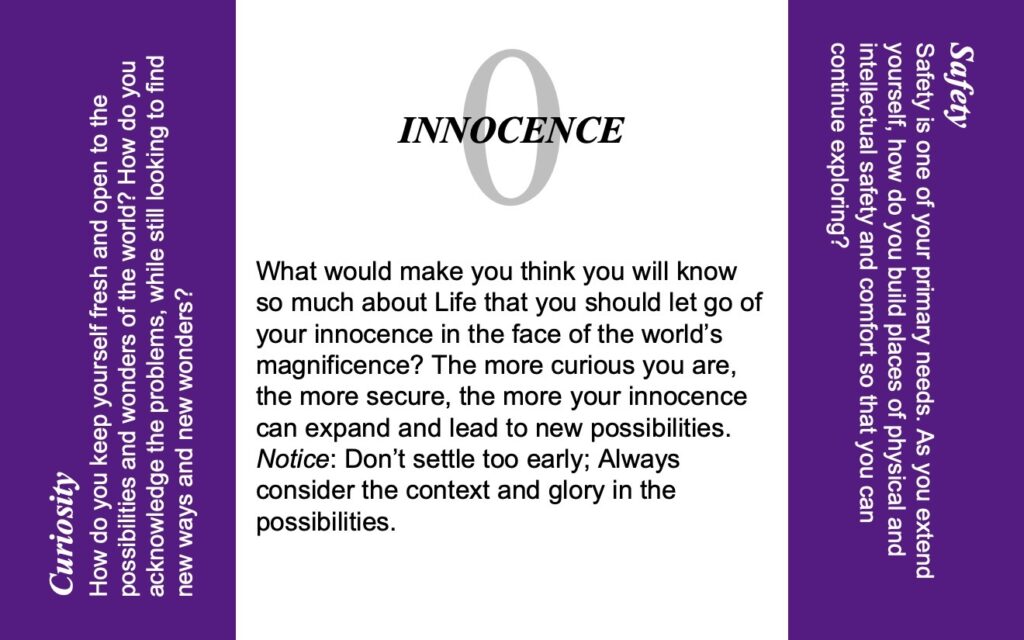
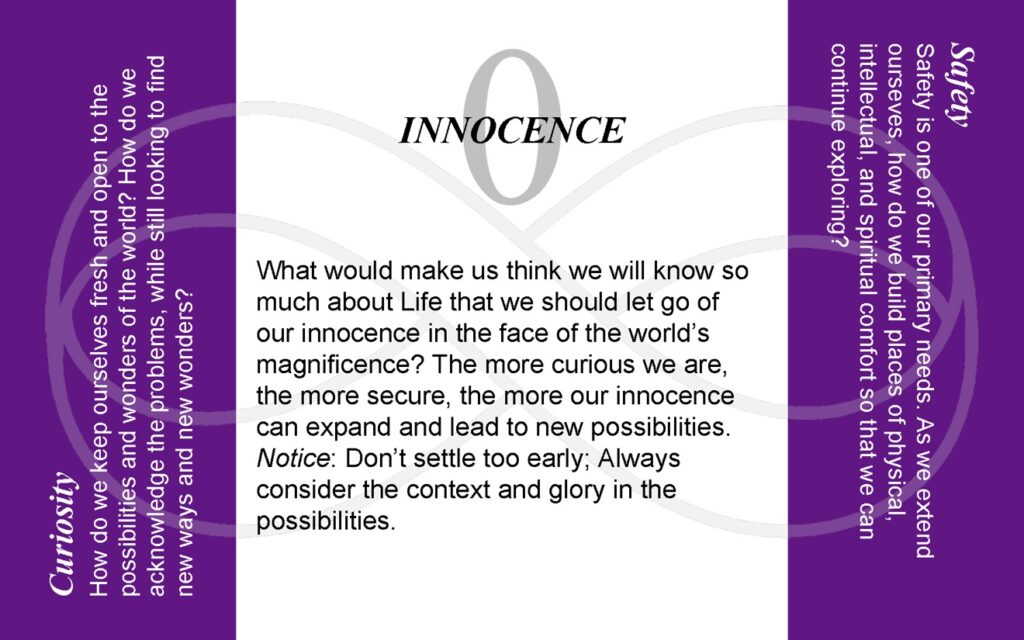
While thinking through all that, and in the midst of completing a task my web guru set me, I was closely rereading my deck, realizing that there were typos and grammos in them. Oops. So, he and I sat down to make that situation better, and I realized that these cards were directed toward the first-person singular. The more I read, the more I understood, my work as a Peacemaker is a communal. If I’m to call these cards Peacemaker’s Tarot, they need to be creating communal Peace. Of course, they will still continue to inform personal Peace. But my language in the cards and in my everyday work, needs to change direction and become cards addressing the collective and looking to build healthy community.
Original Text
Revised Text
So this has me thinking — how do I reframe not just my cards, but also my reflections to include everyone. How do I encourage us, how do we choose community, choose as Simone Campbell reminds us to be “We the People” forming a “More Perfect Union?”
Salaam, Shalom, Peace, Blessed Be.